Sunday, March 27, 2016

Sand Canyon - Rodecker Flat

Map Track Link

Bird List

A couple of weeks ago Bob and I had the plan to head into Sand Canyon and visit Rodecker Flat, but instead we got distracted and went to the furthest reaches of the North Fork of Sand Canyon.  Needing an easy hike, we decided to try again today.

Plodding along the easy trail, our bird of the day was just inside the wilderness gate -- a Eurasian Collared-Dove.  Now, don't everyone get excited all at once.  This invasive species has been seen in several of the canyons associating with houses.  This one was blazing a new trail that cut people out of the loop.  Let's hope it doesn't succeed as I don't want them everywhere I hike.

The annual flowers in the lower canyon were done for the year, but the perennials were starting their show.  Flannel bush, desert peach, and Salvia dorrii were looking lovely and kept our minds off how dry everything else looked.


Flannel Bush


Desert Peach
Next we came to a very nice healthy stand of gray pines.


Gray Pines and Owen's Peak
And then we crested a hill and I saw a hillside of yellow.  It was a thousand feet higher than us and straight up.  I was drawn to it like a moth to a flame and immediately proposed it as our destination for the day.  Bob was incredulous, this being a supposedly an easy day, but game, so up we went.  I went from plodding along to the little engine who could.  Yep, I think I can, I think I can, and soon I was reveling in the midst of yellow loveliness.  Oh boy.  Bob then proposed that we should at least bag the top of hill on our way back to our regularly scheduled Rodecker Flat hike.  So, back into plodding mode I went.


My hillside of yellow with the peak we would bag looming above

When we got to the top, we found even better annual flowers, mainly Scale Bud and Coreopsis.  Not only were they beautiful to look at; they smelled great too.  So, with a flower display for me and mountains for Bob, we had our lunch break.  It was fabulous.


Bob the peak bagger


Flowers everywhere


Scale Bud and a Coreopsis
Owens Peak beyond the flowers
We dropped down the backside of our peak and wandered through the Joshua trees, oaks, and cottonwoods of Rodecker Flat.  While this area looks like prime bird habitat, I have never had much luck with birds there.  We eventually had a Cactus Wren and Ladder-backed Woodpecker which put us at 28 species for the day.

I expected the final dry part of the hike to be boring, but we found a couple of interesting reptiles - a Leopard Lizard, and then a Desert Tortoise at 3330'.  Both allowed their photos to be taken.  Very nice.


Desert Tortoise


Leopard Lizard

Saturday, March 26, 2016

Sacatar Trail

Map Track Link

Bird Lists:

Lower Sacatar Trail
Little Lake Canyon
Sacatar Crest


Sunrise on the trail
Before there was a route over Walker Pass, or a road blasted into the rock in Nine Mile Canyon, there was a wagon trail from the Owens Valley to the west side. This "road" was used by the military and others dating back to the 1800's. The Sacatar Trail leaves Rose Valley just a few miles north of Little Lake contouring the edge of Little Lake Canyon finally reaching a low pass in the Sierra at 7,400 feet and entering Sacatar Canyon. Today this historic trail is protected inside the Sacatar Trail Wilderness - created in 1994 with the passage of the California Desert Protection Act. While time and erosion have taken a toll on the trail and it is no longer wide enough for a wagon, it is still very passable on foot. 

The contouring nature of the trail keeps the grade moderate over the 8 trail miles to the crest. In fact, it winds around so much that the straight line distance from the pass back to the trailhead is only about 4 miles, but up nearly 3,500 feet in elevation. As with most east side Sierra trails, there is much climbing to be done!

We got an early start and watched the sun rise over the Coso Mountains to the east. We climbed steadily among outstanding flowers all the way to the Pinyon Pine habitat zone at around 6,500 feet. Birding was good for a dry slope with many Bell's and Black-throated Sparrows singing us along. Chukar and Rock Wrens were represented well. There was even a Lark Sparrow in full song at about 5,000 feet elevation. In the afternoon we had numerous Western Bluebirds and Pinyon Jays cavorting on the hillsides. Over 30 species for the day was impressive for such a dry area. 


The trailhead at the foot of an unnamed canyon north of Little Lake Canyon

North toward Owens Valley

Good flowers abound

South toward Little Lake and the Indian Wells Valley

The trail winds along a gentle contour

Miner's Lettuce

Purple Sage (Salvia Dorrii)

Purple Sage (Salvia Dorrii) 
Locoweed

Traversing toward the edge of Little Lake Canyon

Eveningsnow

Rose Valley

A 270 degree panorama. The perspective is skewed, but shows the entire view from north to south.

Wallflower

Wallflower
Little Lake Canyon is steep and rugged. As the trail traverses high above, the view down is impressive. 


The steep and rugged Little Lake Canyon

Coreopsis and Scalebud adorn the trail

Scalebud

Scalebud

Forget-me-not

Not sure on this one yet, working on an ID and will edit in later


Reaching the pinyon pine habitat zone

Pinyons and flowers

The trail levels out substantially at the head of Little Lake Canyon just before crossing the crest. It is so level that views in both directions are essentially blocked by the trees. So after a nice lunch break we picked a rocky knoll to climb for a view. It was worth the effort as all of Sacatar Canyon and many mountain peaks beyond were revealed. 

It was time to go back - down, down, down to the desert floor below. The afternoon light made for outstanding views in all directions and made the return very enjoyable.


The head of Little Lake Canyon

Beetle tracks in a tree that has fallen across the trail

Pass across the Sierra Crest

Sacatar Canyon

Smiling "monster" rock

Looking down Little Lake Canyon from the top

Corepsis and Scalebud

Heading down

Directly across Rose Valley are Red Hill and Volcano Peak. This area is still geologically active with a geothermal plant currently in operation

The captivating smell from these popcorn flowers is intense

Gilia and popcorn flower

Gilia

Gilia

Thursday, March 24, 2016

Mill Creek - Sierra Newts!

Map Track Link

Bird Lists:

Mill Creek Canyon
Conifers at 5,800 feet elevation


Mill Creek Canyon
After two days indoors hiding from the wind and finishing resupply boxes, we were off to the Kern Canyon again with the intent to get a good training hike and see a special amphibian - the Sierra Newt. Mill Creek is well know as a great place to see this red salamander. The passage of a weather front made for a cold morning so when we got to the four creek crossings in the lower canyon we were not surprised there were no newts to be seen. We would have to wait for the return trip in the afternoon.

Mill Creek Canyon has historical roots as a pack trail from Kern Canyon up to Breckenridge Mountain. At some point in the past it was converted to multi-use with some of the trail re-routed to avoid erosion. Unfortunately not all of the trail has the gentle grade necessary to keep wheeled vehicles from creating erosion paths and some of it is in pretty rough shape. Clearly not as good at the trails we saw on the north side of Kern Canyon a couple weeks ago. It was a case of what can (and should) be done when designing trail for multi-use. But that is an argument for another day...

The trail leaves the old Kern Canyon Road near the Mill Creek bridge and gently contours for a couple of miles past several stream crossings before beginning the steep ascent toward Breckenridge. The flowers on this north facing slope were still in great shape. As we moved through the bottom grasslands we saw large stands of popcorn flower, owl's clover, and many others. It was steep as we climbed over 4,000 feet in elevation in just 7 miles. Passing through oak grasslands we reached the beginning of conifers at about 5,800 feet elevation. 

Birding was excellent all day. Spring is happening and the birds are announcing it. The resident Oak Titmice were singing constantly from what seemed like every tree. Orange-crowned Warblers are back as we heard many singing for a mate. And the House Wrens have returned in force, their staccato song accompanied us most of the way up the lower canyon. We had our first Blue-gray Gnatcatchers of the year with a pair foraging in a bush, the male singing his raspy song incessantly. We found one of the locally uncommon Hutton's Vireos as he gave his harsh song note and put us on his location. At the higher elevations we added Mountain Chickadee and Steller's Jay. Over 40 species for the day made for a pretty good outing this early in spring. 


Multi-use Trailhead

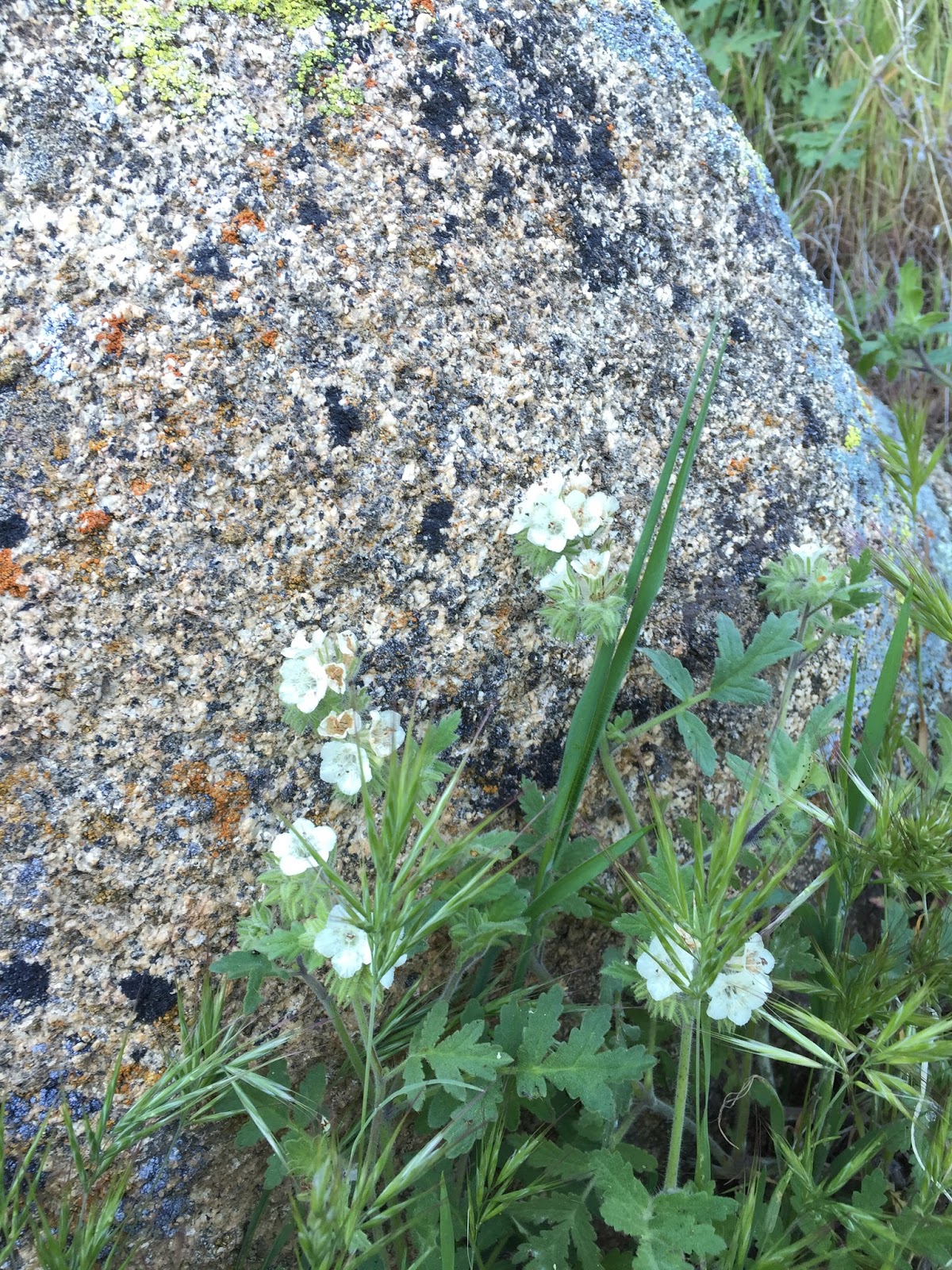
White Phacelia


Owl's Clover and Popcorn Flower

Large fields of grass and flowers

Mill Creek Canyon

Sream crossing

California Indian Pink

Owl's Clover and Goldfields

Upper Mill Creek Canyon

Historic Native American acorn grinding holes

Grinding holes

Buttercups

This is an open grazing area, so we had company at times

Canyon view

Yucca flowers are emerging

Large areas of substantial trail erosion

Up toward the top of Breckenridge

Hiking into the conifer zone

Large conifers above 5,800 feet elevation

A winter of decomposition has left this leaf "see-through"

View to the north. Using binoculars we could see the west side of Mount Whitney many miles away

Manzanita in full bloom

Goldfield and Cream Cups


Back down in the canyon bottom it was time to go Newt hunting! At the first downhill stream crossing Susan found one almost immediately. Then another, and another! The little red guys were active in the warm afternoon and we stayed a while to watch and photograph. Susan had seen them before but this was my first time. Very cool!


We finished up the last couple miles walking through gorgeous flowers in lovely afternoon light.