Bobby and Chandler wanted to go backpacking. Oh boy! We were in charge of the logistics. The kids did a 17 mile hike a month or so before, so we decided on a short, but steep trip to Gable Lakes. At just under four miles, the distance isn't the problem. The elevation gain, 3000 feet, and extreme lack of trail maintenance are the problems. We did just fine getting to camp and had time to set up tents and play in the lake before the rain set in. By play in the lake, I mean I touched the water. Bobby and Chandler did much better than I and dunked themselves. Rarely have I laughed so hard as at their reactions. That water is cold, mighty cold.
Looking at Pine Creek Canyon and the mill.
One of the tram towers. Every time we go, fewer of them remain upright.
Chandler and Bobby demonstrate how steep the trail is.
One of the best preserved towers.
One of many downed trees to get through or around.
Love those junipers!
One of the best pieces of trail.
Fireweed
Bob is in there too.
Notional trail.
Bobby and Chandler
Our camp and stormy weather.
Chillin' before the rain.
Sunset
Having three days, we went to explore the other lakes on the second day. Bob had never been, so this was a big draw for him. I had been, but it had been so long I only had vague recollections that they weren't as scenic as where we camped. It turns out the middle lake was lovely and had tadpoles. Lots of tadpoles. I didn't remember that there were critically endangered Sierra Yellow-legged Frogs there.
We start the day with a beautiful sunrise.
I also didn't remember all of the mining stuff. My brain came up with the cabin, which has been squashed by one of the recent bad winters, but further up, there is lots of stuff. It is the Lakeview Mine and mill. From Owens Valley History the tungsten deposit was discovered in 1940 and ore was hauled down by mule. In 1953 George Brown's mules packed in everything for a mill including a jaw crusher, gravity table, and engines to power it all. Glad I wasn't one of those mules. The price of tungsten was high as the government was stockpiling it. When that ended in 1957 so did the mine as it was no longer profitable. Gable Lakes 1977 is a fun write up of visiting Gable Lakes and the mill in 1977 and has a great picture of what the cabin used to look like. A good write up of the Pine Creek, Mt Tom and Gable Lakes mines can be found here. It even shows the buckets on the trams that go to the Tungstar Mine. The book Mine in the Sky by Joseph M Kurtak is really fascinating if you can find it. Lots of photos and lots of stories from the miners who worked in the Pine Creek area.
Hey, that is a mill on the hillside.
Chandler and all that remains of the cabin.
Sierra Columbine
We are camped back up in there.
Loads of mine junk.
The mill
What a cool old wheelbarrow.
You don't see this on the shelves today.
I can't remember what these are for.
Our car is down at the bottom somewhere.
Is it a stream or a hiking route?
Wow, what a clear lake!
Sierra Yellow-legged Frog tadpole
Checking out the local flowers.
Inyo Tonestus (Tonestus peirsonii), a highly localized rare flower
Mountain Coyote Mint
We get back again before the rain.
Enjoying the evening.
Our third day was simply coming back down the "trail" to the trailhead. This isn't trivial as the upper part of the trail is notional, and the middle part is filled with downed trees and completely overgrown. And the whole way is rocks that twist your ankles that make for slow going. I think Chandler found this day the toughest of the three. I am sure Bob and I will be back if our bodies hold out because we like the birds, the history and the flowers, but it might be the only time Bobby and Chandler ever go. There are plenty of nice spots in the Sierra that are so much easier to access.
We headed to Idaho to visit my mom and visit a few places for scenery and flowers. New to us were the Teepee Rocks. I heard about these from a random Facebook spam post. Who knew random spam could be useful.
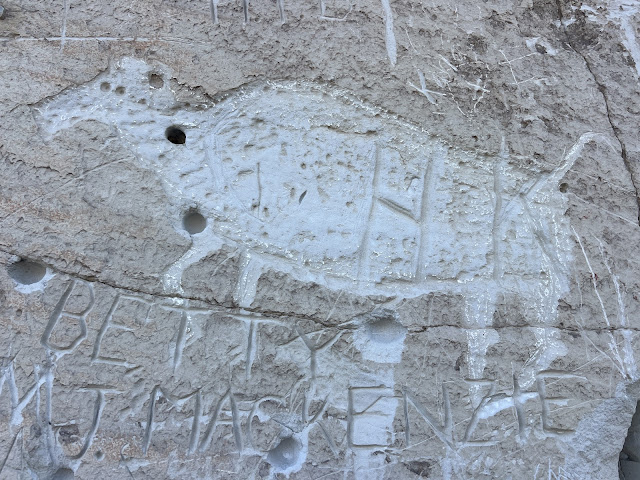
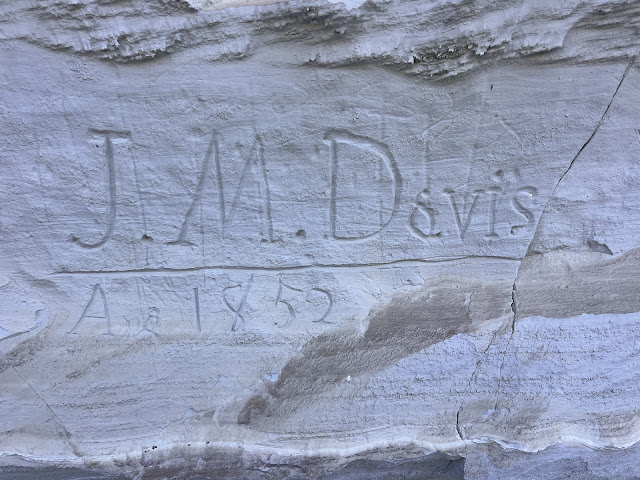
The teepee rocks were fun. Even more impressive were the petroglyphs on the way there. I had no idea these existed. Even crazier, I can't find anything about them online. From the BLM sign by them, that begs people not to destroy them, they are older than 50 years. Are they a 100 years, more, who carved them, Native Americans, settlers, both? So many questions, and I have no answers. I suspect this rock has been important for hundreds of years, but the modern destruction made much of it hard to decipher.
An artist created this elk.
Some of these look ancient.
A buffalo? So many unanswered questions.
Teepee Rocks
The oldest graffiti signature we could find.
Sego Lily (Calochortus nutallii)
Flexible Milkvetch (Astragalus flexuosus)
Anderson Larkspur (Delphinium andersonii)
Western Blue Flag (Iris missouriensis)
We also headed to Camas Prairie Centennial Marsh for our yearly look at camas lilies. We were shocked at what a bad year they were having. What were having a good year were the Mormon Crickets. Creepy!
Small Camas Lily (Camassia quamash)
Our other trip was to Craters of the Moon National Monument. We wanted to see the spotted fritillary. We found some nice ones, but the numbers were down from last year. Other flowers were in abundance.
Miniature Monkeyflower (Erythranthe suckdorfii)
Dwarf Purple Monkeyflower (Diplacus nanus)
Both together
These hills are covered with flowers. Most so small, they are hard to see.
Silverleaf Phacelia (Phacelia hastata)
Spotted Fritillary (Fratillaria atropurpurea)
Spotted Fritillary (Fratillaria atropurpurea)
Cushion Buckwheat (Eriogonum ovalifolium)
Brandegee's Onion (Allium brandegeei)
Indian Tunnel and Dewdrop Cave lava tubes were open, so we spent some time exploring those as well.